Do you remember that moment from childhood when you picked up a crayon and just — drew? Without thinking, without comparing, without a voice in your head saying "that doesn't look like anything real"? Or maybe you don't actually remember that moment, because you were always being judged.
For many years, I was convinced that I simply couldn't do it.
Where that "I can't" even comes from
Most of us, at some point — somewhere between the ages of eight and twelve — stopped drawing. Not because we lost the desire. Because we started comparing. We saw someone else's drawing in their notebook, heard a teacher's comment, or simply realized that our house and sun didn't look the way they were supposed to.
Art class in school, and the broader social belief around it, rests on the idea that drawing is a technical skill you either have or you don't — that there's such a thing as artistic talent, innate and obvious to anyone who looks. And yet the reality is completely different. Creativity isn't reserved for the chosen few. It's a need we all carry within us — like breathing, like sleep, like a conversation with someone we love.
Drawing isn't about producing masterpieces. It's a way of expressing yourself and a wonderful tool for personal growth.
What it means to draw in tune with yourself
Drawing in tune with yourself means creating from the inside out, rather than from external expectations. It's not a technique. While tools and inspiration are helpful, what matters most is the attitude you bring to the page — I can try something today.
Imagine sitting down with a cup of tea, opening a sketchbook, and drawing without a plan. Or even just colouring in a few motifs — not the "right" way, but your way, whatever flows out of you. If coloring sounds like a good place to start, read how to start adult coloring — a complete guide for first-timers.
That is drawing in tune with yourself. Mindfulness — toward yourself and what you enjoy, instead of perfection. Curiosity about what's inside you, instead of control.
Drawing as a mindfulness practice
When you draw mindfully — truly mindfully, considering your colour choices in a way that feels right for you — you stop thinking about the shopping list, the email to your boss, something you said yesterday and whether it came out the wrong way. We write more about this meditative power of creativity in Nature-Inspired Coloring as a Mindfulness Practice. This is what Csikszentmihalyi calls flow, and it's one of the most restorative states our nervous system can experience.
Japanese culture has a word for this: shibui — a beauty that reveals itself slowly, in focus, in simplicity. I think that drawing without ambition, without a plan, purely for the sake of the act of creating, is exactly that kind of beauty.
It's worth carving out a moment — a short one, even just fifteen minutes — that belongs only to you. Maybe in the evening, already in bed. Maybe on the bus. Especially if you can take your little studio with you. :)
You don't need to wait for the right moment. You don't need to buy special supplies. But if you already have a set of pencils or coloured pencils somewhere in the house — take them out. Put them where you can see them.
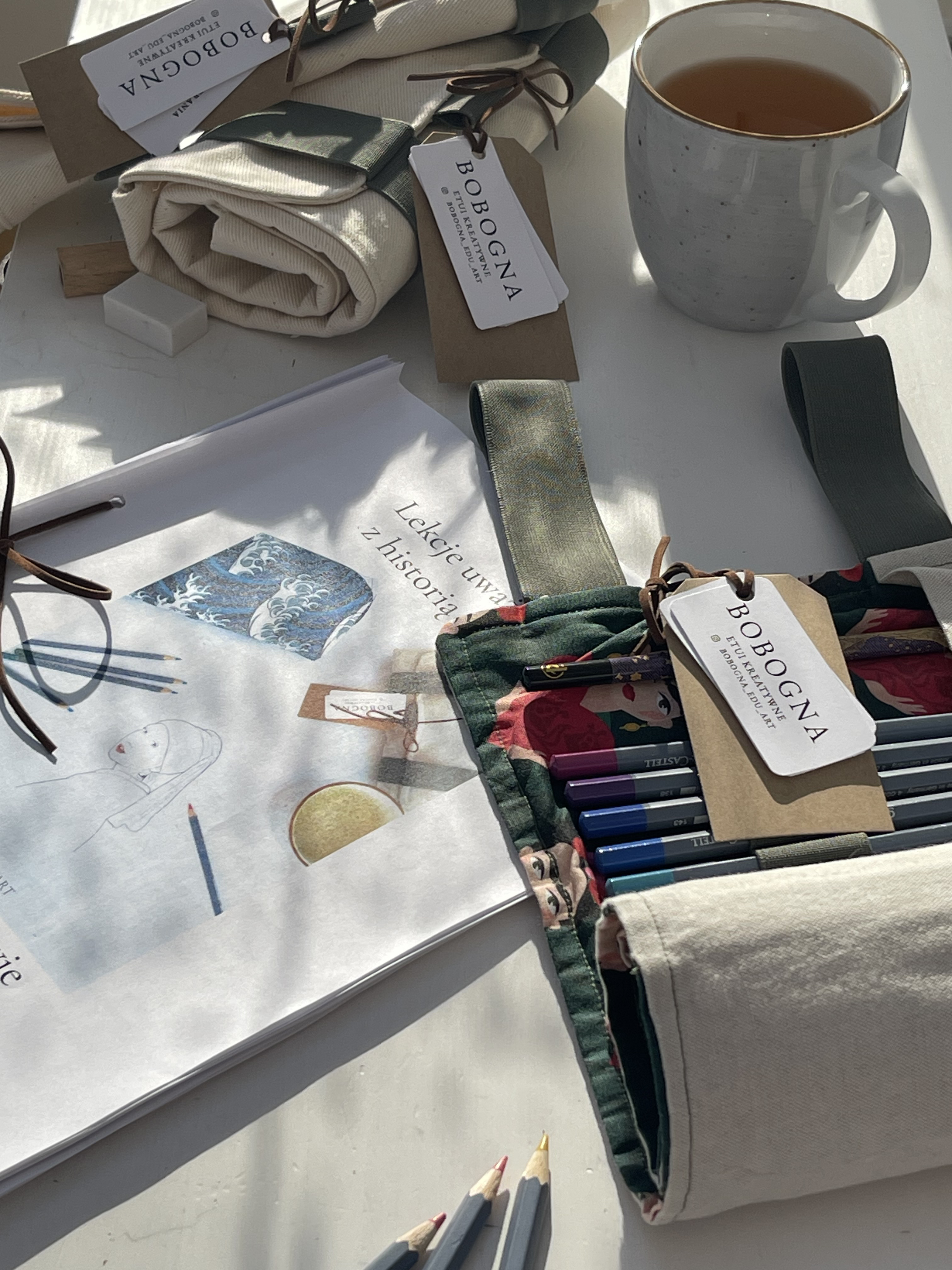
Because drawing, like any practice, needs an invitation — a space made for it. And I hope that a Bobogna pencil case will be exactly that kind of invitation.