Why Coloring Is for Everyone
Adult coloring isn't child's play — it's a conscious return to that state of flow that psychologists simply call flow. When we focus on filling outlines with color, our thoughts slow down, our breathing deepens, and the present moment becomes everything that exists.
Research published in the Art Therapy Journal shows that just 45 minutes of creative activity significantly lowers cortisol levels — the stress hormone — regardless of any prior artistic experience. You don't need to know how to draw. All you need to do is pick up a pencil.
Creativity doesn't need talent. It only needs time and the courage to begin.
What Tools to Choose When Starting Out
Colored Pencils
To start, a set of 24–36 good-quality watercolor pencils is more than enough. I'd recommend brands like Faber-Castell, Staedtler, or Derwent — their pencils have a soft core that glides easily across paper and blends beautifully.
What to avoid? The cheapest school sets — they have hard cores that scratch rather than smooth. The result feels frustrating instead of relaxing. For a deeper look at the different types of pencils, read our guide How to Choose Your First Art Pencils.
Markers and Pastels
Once you feel more confident, it's worth trying dual-tip markers (Copic, Artline) — they deliver intense, vibrant colors that are perfect for filling in larger areas. Oil pastels, on the other hand, allow for gorgeous color transitions using the sfumato technique.
Paper Matters
Don't color on thin office paper. A good coloring book should be printed on paper that's at least 160–200 g/m². Heavier paper won't warp with moisture and allows you to layer colors beautifully.
How to Choose Your First Coloring Book
It really comes down to your personal taste and patience. Here are a few tips:
- Start with simpler patterns — geometric mandala designs are perfect for absolute beginners; we explore how mandalas connect to mindfulness practice in our article Nature-Inspired Coloring as a Mindfulness Practice
- Fine art masterpieces — coloring books inspired by Van Gogh, Vermeer, or Hokusai demand more attention, but the satisfaction they bring is immense
- Nature motifs — flowers, leaves, and animals are a classic that never gets old
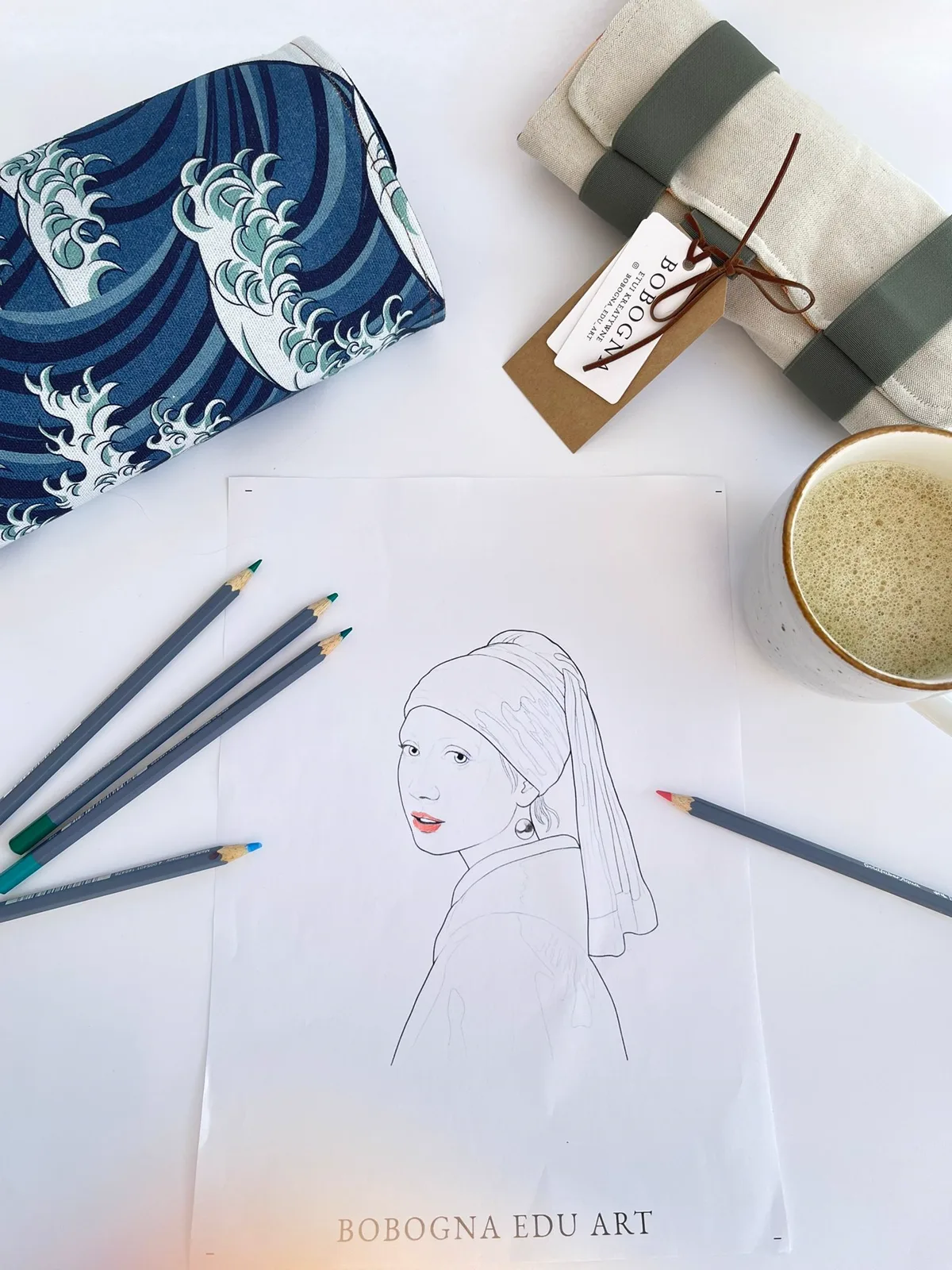
At Bobogna Edu Art, we create coloring books inspired by the world's greatest paintings. Our Girl with a Pearl Earring coloring book based on Vermeer is one of our most beloved — its soft lines and delicate expression are a true challenge even for experienced colorists.
How to Create Your Own Coloring Ritual
The meditative effect of coloring grows stronger when you treat it as a mindful ritual:
- Choose a regular time — in the morning with your coffee, or in the evening with a glass of wine. Consistency builds habit.
- Set up your space — a good lamp, your favorite music in the background, a cup of tea. A little simplicity goes a long way.
- Turn off notifications — 30 minutes without your phone. Your brain will thank you.
- Don't judge the results — there are no mistakes here. The sky can be red if that's how you feel it.
- Take a photo of your finished work — and share it! Seeing your progress is genuinely motivating.
Coloring isn't a race. It's a walk, not a sprint. Enjoy every stroke of the pencil.
First Steps with a Bobogna Coloring Book
Our coloring books are available as free sample downloads or as full printed editions. Every page is an original composition drawn entirely by hand — nothing is computer-generated.
With every artistic pouch from the Bobogna collection, we include a small poster-coloring page featuring a motif that matches the fabric pattern. It's our way of bringing together functionality and creative inspiration.
Start today. Pick up a pencil, open a window, and color for 20 minutes. You'll find that time simply stops existing — and that, right there, is the magic.