
June 1889 — a window onto the sky
Vincent van Gogh painted The Starry Night in June 1889, during his voluntary stay at the Saint-Paul-de-Mausole psychiatric asylum in Saint-Rémy-de-Provence. He was 36 years old. He had fourteen months left to live.
Shapes that move us
In The Starry Night, three kinds of movement capture our attention:
- Spirals — a swirling sky, galaxies and nebulae forming almost astronomical vortices
- Horizontal waves — gentle bands of cloud weaving through the glow of the stars
- Vertical lines — a slender, stately cypress tree standing in the foreground
The cypress — a symbol of death in Mediterranean tradition — dominates the canvas. Yet there is nothing gloomy about it. It rises like an arrow aimed at the sky, like a bridge between the earth and the cosmos.
A painting that went unrecognised in its time
Like so many great works of art, The Starry Night received no recognition during the artist's lifetime. Van Gogh sold just one painting in his entire life. He himself wrote about this canvas with reservations, feeling it was too detached from reality.
After Van Gogh's death in 1890, the painting passed to his brother Theo. Today it belongs to the collection of the Museum of Modern Art (MoMA) in New York.
It is estimated that more than 5 million people visit The Starry Night every year. It is one of the most recognised paintings in the history of human civilisation.
Why we chose it for Bobogna
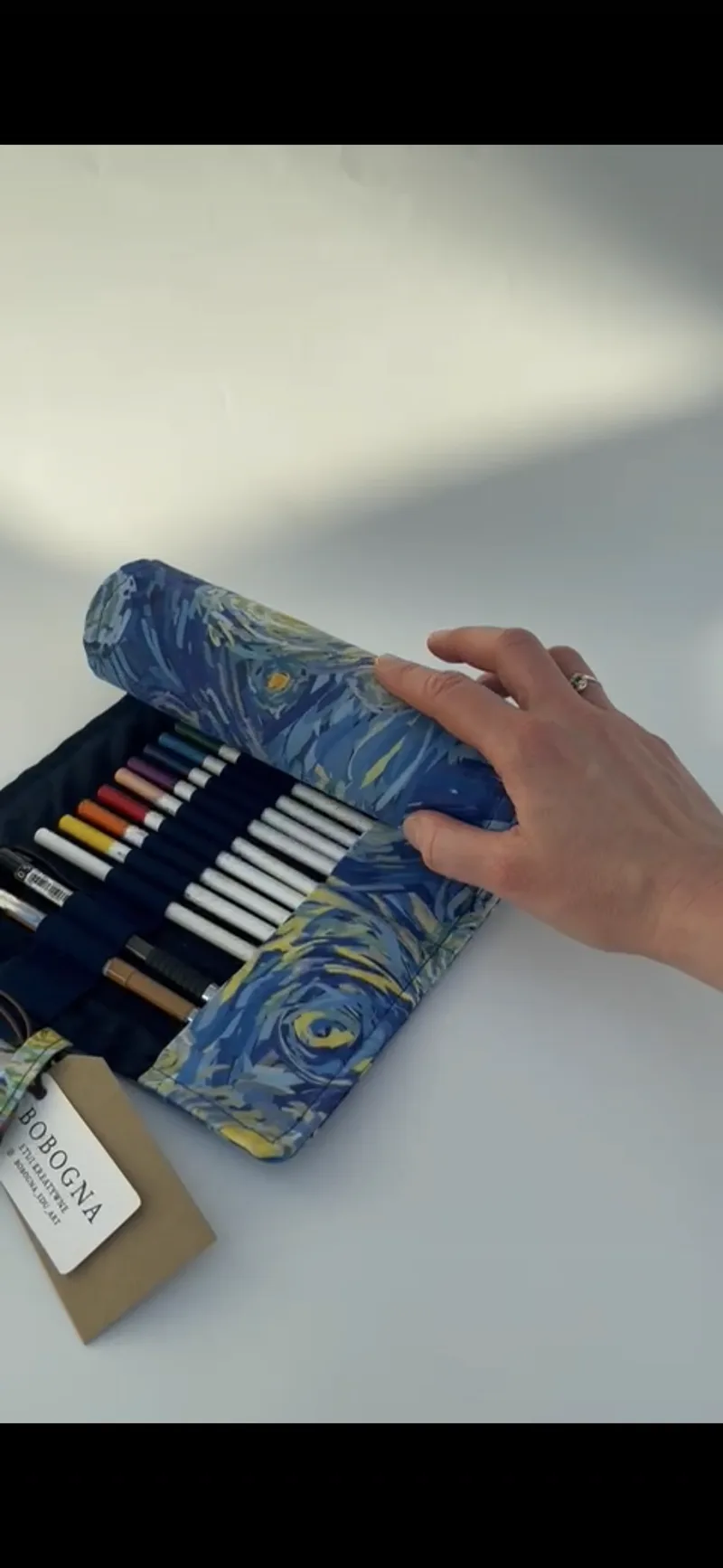
When I was creating the Bobogna collection, I knew that The Starry Night simply had to be on a pencil case. There is something in it that resonates with a contemporary audience in a way no other work quite does.
Our Starry Night pencil case is made from high-quality cotton canvas, using a thermal sublimation technique that preserves the full richness of colour and detail found in the original. Each case holds 36 pockets — room for coloured pencils, brushes, fountain pens, and everything else you need to create.