The sight of a freshly sharpened pencil, the feel of paper beneath your hand, and spread out before you — a vast meadow, enclosed and waiting for color. There are moments when the simplest things turn out to be the most healing.
Nature as inspiration is one of those themes I could spend hours with — sitting by the window, a cup of tea in hand, a bundle of pencils or colored pencils nearby. Not because it's a trendy thing to do, but because something in that gesture — in slowly filling the shape of a leaf, a flower petal, or the silhouette of a horse with color — reminds us that we are part of something larger. That nature lives inside us, even when we're sitting in an apartment.
Why does nature draw us so powerfully to our coloring pencils?
Psychologists have long spoken about a phenomenon called biophilia — an innate, deep human need to be in contact with nature. Edward O. Wilson, who popularized this theory, argued that our psyche evolved over millions of years surrounded by trees, rivers, and animals — and that this connection is simply something we need to thrive.
But what happens when we don't have a forest nearby? When the closest park feels far away and it's been raining outside for a week? When we can only get there on weekends? And even when nature is close, it can feel distant — because over the years, we've learned not to notice it, and in doing so, we've grown less attentive to what is beautiful.
That's where creativity comes in. And the simplest entry point of all is coloring.
The growing fields of mindfulness and art therapy consistently show that even imagining nature — coloring its shapes and forms — engages exactly that same space in the imagination. It lowers cortisol levels, slows the heart rate, and quiets the nervous system.
Mandalas as nature expressed in geometry
I can't write about nature-inspired coloring pages without mentioning the mandala. It's one of the oldest patterns in human history — present in Hinduism, Buddhism, but also in the symbolism of Indigenous Americans and in the architecture of Romanesque churches.
Fibonacci, the golden ratio, radial symmetry — these are not human inventions. They are patterns that existed long before people arrived: in the spiral of a snail's shell, in the arrangement of sunflower seeds, in a snowflake, in the cross-section of an apple. When you color a mandala, your hand traces the very same laws that govern the growth of crystals and the formation of galaxies.
If you're not sure where to begin — reach for a mandala.
How to start: practical mindfulness with colored pencils
If you'd like to try coloring as a well-being practice, I have a few suggestions. Not rules — suggestions. Because in any kind of growth, freedom is what makes you feel safe enough to begin.
Start by choosing a subject that moves something in you. Not the one that seems "right" or "easy." Maybe it's a detailed illustration of a fern. Maybe it's the silhouette of a horse mid-gallop. Maybe it's a mandala with a floral motif. Listen to yourself.
Before you start coloring, take a moment to simply look at the outline. What do you see? What colors appear in your imagination? Do you want to stay true to nature — a green leaf, brown bark — or are you drawn toward something completely different? A purple tree? A golden horse? This is your space. Nature is here as inspiration, not instruction.
Then — color slowly. You don't have to finish. You don't have to fill everything in. Notice how you feel as you choose a shade. As the pencil meets the paper. As color spreads through the space between the lines.
This is meditation. It doesn't require a cushion or silence. It only requires a moment and something to color.
Tools matter — and that's not a cliché
Every ritual needs a supportive space around it. I'm not talking about spending a fortune on professional materials. I'm talking about the fact that when your pencils are sorted, easy to reach, beautifully arranged — you reach for them more willingly. When you have your own little coloring corner, your own place — the practice becomes a ritual rather than a coincidence.
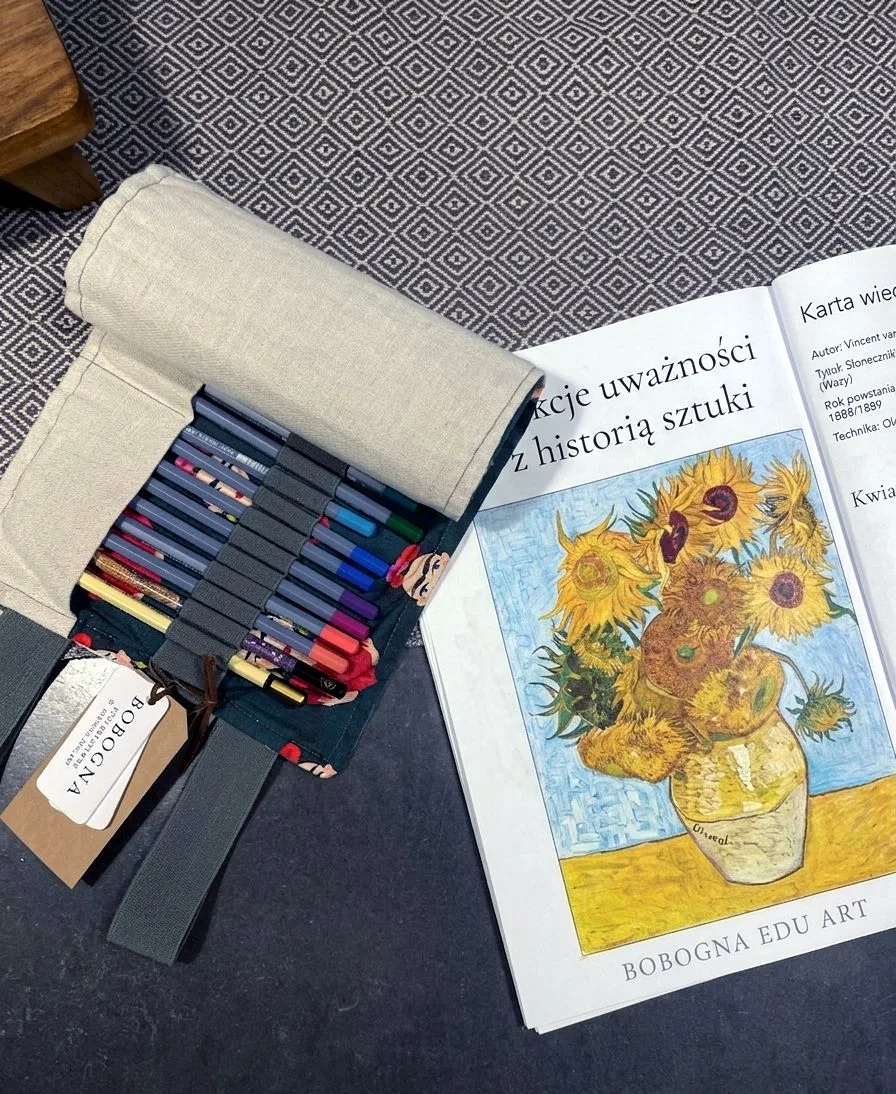
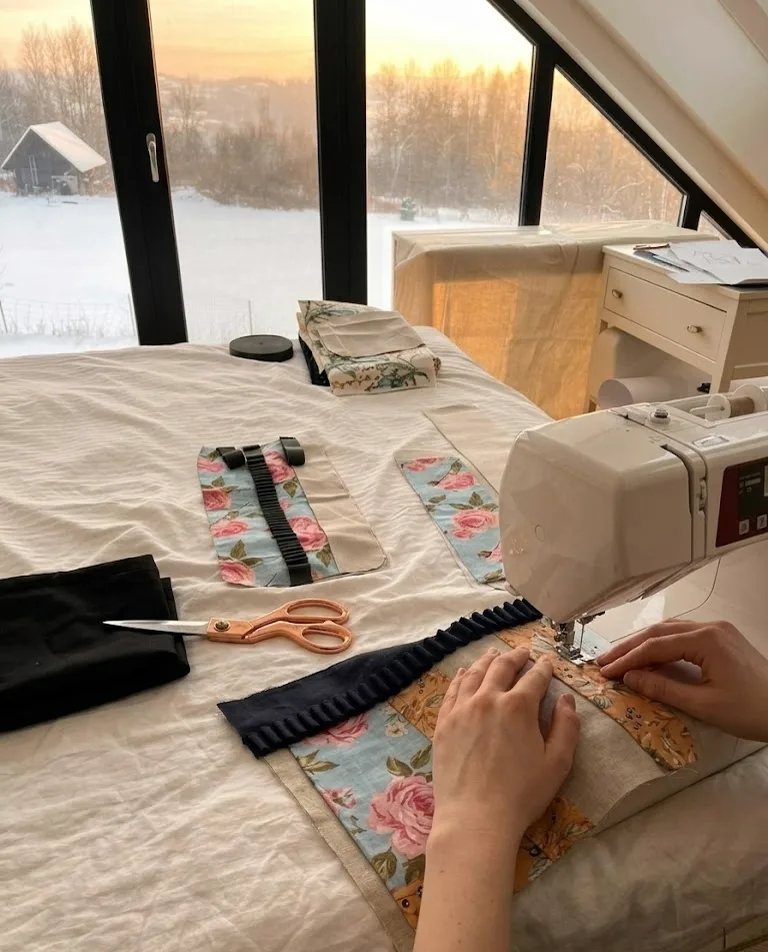
That's why the idea of an art supply case as something more than just storage feels so meaningful to me. At Bobogna, we believe that the place where you keep your tools matters — that a beautiful, hand-sewn case can be an invitation to practice. When you open it, you see your pencils arranged just so, a palette of colors, you touch the natural fabric — and you create a space for growth and for coming back to yourself.