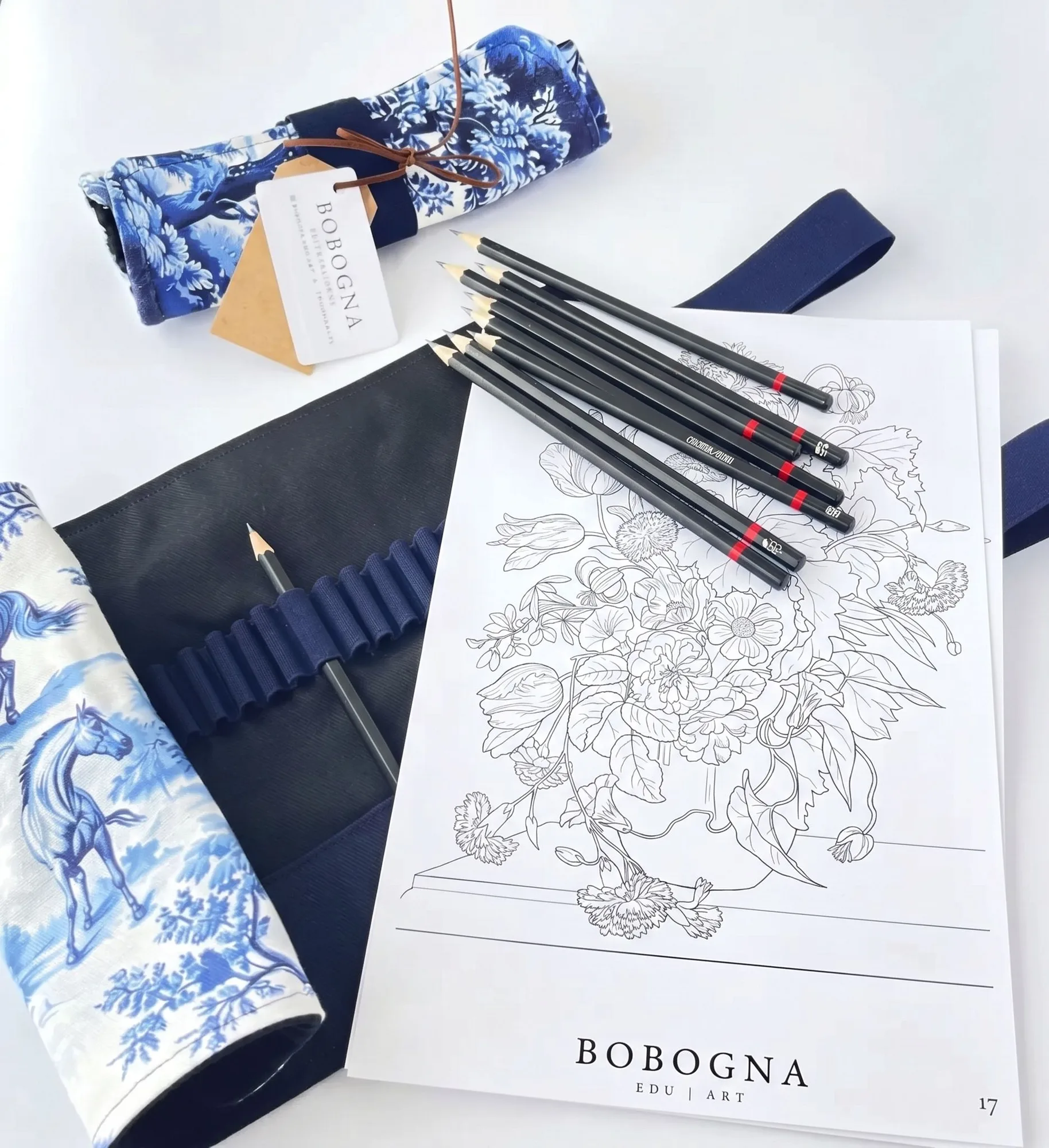
You don't need a meditation cushion, incense, or a special app — all it takes is a page with a flower outline and a moment that belongs entirely to you. Coloring is one of the simplest and most underrated forms of meditation there is.
What happens in your brain when you color
Neuropsychologists have spent years studying why coloring has such a soothing effect, and the answer is both simple and fascinating. When we sit down with colored pencils and begin filling in the outlines on the page, the brain simultaneously engages the amygdala — the center of emotion and stress — and the prefrontal cortex, which handles concentration and planning. This dance between both hemispheres means the mind no longer has room for a rush of thoughts: it's too busy deciding whether that petal should be blush pink or more of a salmon. Especially if you have a wide palette to choose from.
Carl Jung recommended that his patients draw mandalas as a form of self-insight. The symmetrical structure, the repeated gesture, the steady rhythm of pencil on paper — all of this builds inner quiet faster than most of us can achieve by sitting motionless with our eyes closed. That's precisely why mandala coloring has become a global phenomenon: it isn't a trend, but a return to something very ancient and deeply human.
Coloring also works beautifully as a bedtime meditation — swapping screens for colored pencils in the half hour before sleep signals the nervous system that it's time to wind down. Blue screen light stimulates; the rhythm of coloring calms.
Eight masters and one lesson in mindfulness
A few more gems of inspiration from great artists:
Claude Monet spent hours watching how light changed the color of water from one minute to the next. He practiced sensitivity — and you can taste it too, by allowing yourself to use three shades of blue where your instinct says one is enough.
Vincent van Gogh saw flowers dancing and radiating pure energy. His expression means letting the pencil follow the feeling rather than photographic accuracy. Van Gogh painted in Saint-Rémy surrounded by wildflowers — and it was there that some of his most charged and vibrant works were born.
Albrecht Dürer bent close over a simple patch of grass and saw an entire microcosm within it. His mindfulness is an invitation not to rush on to the next petal until the one before you has truly been seen.
Gustav Klimt transformed a meadow into a precious, ornate tapestry. Decorativeness as a creative stance means that every centimeter of a flower deserves adornment and care — coloring stops being filling in and becomes embellishing.
Stanisław Wyspiański drew plants as if each one had its own rhythmic outline pulsing with life. Line as meditation — before you reach for color, let your eye travel along the outline and feel its rhythm.
Rachel Ruysch, the Dutch master of still life, hid small creatures among the petals: insects, snails, drops of dew. Her patience teaches us that it's worth lingering in one place longer than we think necessary.
Paul Cézanne looked at nature as a construction of colored patches — structure hidden beneath the soft surface of a flower. Try seeing a petal as a collection of geometric fields of color, and the act of layering hues will take on an almost architectural depth.
Georgia O'Keeffe painted flowers so close that they lost their shape and became a new, abstract world. Scale as a lesson: choose one detail in your pattern and fill it as if it were the entire composition.
Why flowers are the perfect subject for meditative coloring
Nature and meditation have been intertwined for thousands of years — Tibetan monks paint mandalas filled with lotus blossoms, and Japanese mindfulness practice returns again and again to the contemplation of cherry flowers. Nature-inspired coloring pages work with particular depth because the brain associates organic shapes with safety and calm — it's evolution written into the body.
A flower isn't symmetrical like a mandala, but it has its own rhythm: petal by petal, layer by layer. This guides the hand in a natural, repeated gesture. The green of leaves brings soothing relief, and the complexity of floral patterns gives the mind just enough to do so it doesn't drift into unnecessary rumination.
If you're just starting out and aren't sure where to begin, take a look at our guide on how to start coloring as an adult, where you'll find practical tips on choosing supplies and taking your first steps.
Download your free coloring pages
We've put together a free set of printable pages for you — the ones you've been reading about above. Inside you'll find:
- Single flowers in close-up — in the spirit of Georgia O'Keeffe, for deep contemplation of a single form
- Floral mandala patterns — symmetrical compositions that guide the hand into a calming rhythm
- Botanical illustrations with detail — leaves, stems, buds, and tiny insects nestled among the petals (for those with the spirit of Rachel Ruysch)
- Meadow compositions — multi-layered scenes for a longer session, when you have the time and the desire for a full journey
Print on paper with a weight of at least 120 g/m² — this allows colored pencils to layer beautifully without bleeding through to the other side. Sit comfortably, set your phone aside, put on some quiet music or simply stay with the silence. Choose, with care, the colors that call to you today.
And when you've built your practice and feel ready to take your art supplies somewhere with you — to a café, a park, or out into the open air — our Bobogna cases are sewn with exactly these moments in mind.
Can coloring replace traditional meditation?
Coloring doesn't have to replace meditation — it can be an alternative, or perhaps a beginning, especially for those who find sitting in silence a challenge. It's an active form of mindfulness that great artists practiced intuitively for centuries, and one you can weave into your day without any preparation or ceremony. If you're curious about the broader context of art as a therapeutic practice, you might also enjoy our post on whether you can benefit from art therapy without a specialist.